
AI can help us build a convincing prototype in hours. But what does it take to turn that prototype into something a business can actually rely on?
Part 4 of the series: When Building Becomes Easy, What Becomes Hard?
The demo works.
An AI assistant reads a document, extracts the relevant information and produces a surprisingly useful result. The interface looks polished. The workflow feels intuitive. Someone asks whether the team could start using it next week.
Why not?
After all, the difficult part seems to be done.
Or is it?
AI-assisted development has dramatically changed how quickly we can create working software. Tasks that previously required considerable implementation effort can now be completed in hours or days.
This is an extraordinary opportunity for experimentation.
But it also creates a new challenge: the distance between a convincing demonstration and a dependable business service is becoming less visible.
The code may be working. The business capability may still be far from ready.
The prototype illusion
A good prototype answers an important question: can this idea work?
Perhaps it demonstrates that an AI model can classify incoming customer requests, summarize documents or extract information from unstructured text.
That’s valuable evidence.
But it doesn’t necessarily answer whether the solution should become part of an organization’s everyday operations.
A prototype is often developed under conditions that make success relatively easy.
The data is limited. The use cases are selected. The developer knows how the system is supposed to behave. Errors can be corrected manually. Someone is available to restart the application if it fails.
In a real business environment, those assumptions change.
Users provide unexpected inputs. Source information is incomplete. Integrations fail. Access rights vary. AI models produce inconsistent results. Requirements change.
And someone has to be responsible when things go wrong.
None of this makes the prototype unsuccessful.
It simply means that technical feasibility and operational readiness are different questions.
A demo proves that something can work. A service must demonstrate that it can be relied upon.
The work that doesn’t show up in the demo
Consider an AI application that reviews documents and highlights potential issues.
A prototype might use a language model, a document upload interface and a carefully designed prompt.
The result could be impressive.
But turning it into a dependable service introduces questions that may not be visible in the demonstration.
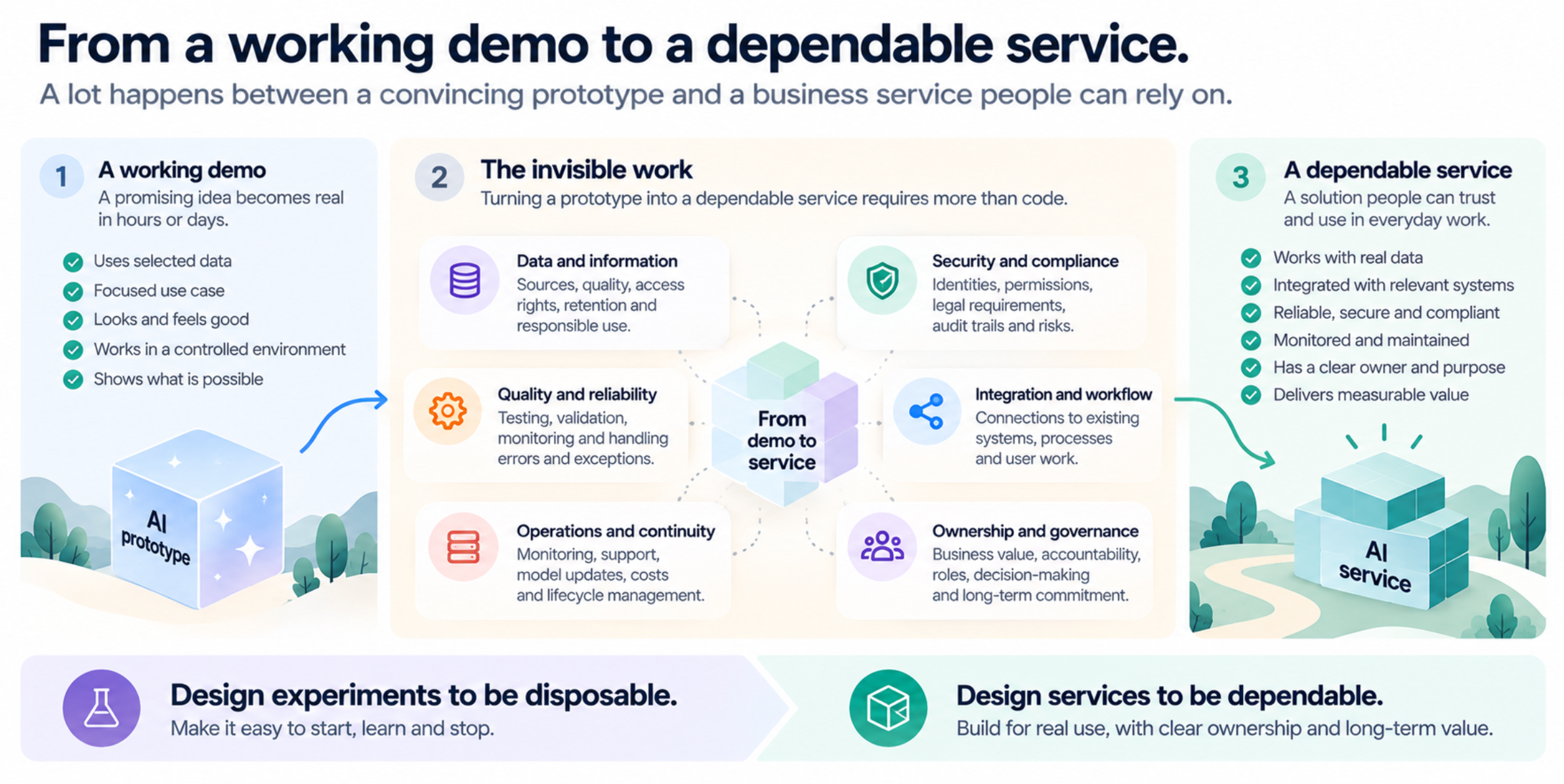
Information and data
Where do the documents come from? Who is allowed to access them? Can they be used for this purpose? How are they stored, retained and deleted?
If the application retrieves information from other sources, how do we know those sources are accurate and current?
What happens when information is missing or contradictory?
Quality and reliability
How do we know whether the AI-generated results are correct?
What kinds of mistakes are acceptable, and which are not?
How do we test the solution against representative cases rather than a handful of successful examples?
How do we detect when its performance changes?
Integration and workflow
How does the application fit into the work people already do?
Does information need to move between systems? Are there existing APIs, services or automation capabilities that should be reused?
What happens when an integration is unavailable?
And does the new solution actually improve the workflow, or does it create another application people need to remember to use?
Security and compliance
What information can the application process? Who can access it? What legal, contractual and security requirements apply?
How are identities, permissions, secrets and audit trails managed?
An isolated environment can reduce technical risk during experimentation, but it doesn’t automatically establish that sensitive information may lawfully be used.
Operations and continuity
Who monitors the application?
Who responds when it fails?
Who pays for its infrastructure, AI model usage and ongoing development?
What happens when the original developer moves on?
Who decides when the service should be updated, replaced or retired?
These questions are familiar to experienced software and service teams.
What’s new is how easy it has become to create something that appears complete before many of them have been considered.
AI doesn’t eliminate the invisible work
AI can certainly help with more than coding.
It can generate tests, documentation, infrastructure configurations and deployment pipelines. It can assist with security reviews, analyze logs and suggest improvements.
These capabilities are valuable, and they may reduce the effort required across the entire development lifecycle.
But generating an artifact isn’t the same as establishing that it is correct, sufficient or appropriate for its intended purpose.
AI can generate a test suite. Someone still needs to understand whether the tests cover the important risks.
AI can suggest an architecture. Someone still needs to evaluate how it fits into the existing environment.
AI can generate deployment scripts. Someone still needs to determine whether the resulting service is secure, observable and supportable.
And AI can help draft documentation. That doesn’t automatically establish who owns the service or who is accountable for its outcomes.
The bottleneck isn’t simply moving from coding to more technical tasks.
It is moving towards validation, integration, organizational decisions and accountability.
These activities can also benefit from AI, but they cannot be reduced to code generation alone.
When a prototype quietly becomes production
One of the most interesting risks isn’t that organizations deliberately deploy unfinished software.
It’s that the transition from experiment to operational service can happen gradually, without a clear decision.
Imagine a team building a small AI assistant using synthetic data.
The experiment works well.
A colleague asks whether they could try it with real documents.
Another team wants access.
Someone connects it to an internal system.
A manager starts relying on its output.
Soon, a prototype has become part of an operational workflow.
But was there ever a decision to establish a new service?
Was its business value evaluated? Were the data processing requirements checked? Was an owner appointed? Were ongoing costs and responsibilities agreed?
Perhaps some of these questions were addressed. Perhaps not.
The problem is that successful experimentation can create commitments faster than the organization recognizes them.
The moment people start depending on a prototype, its failure becomes someone else’s business problem.
That’s why I think organizations need a clearer distinction between permission to experiment and permission to operate.
Freedom to experiment. Clarity when committing.
The answer isn’t to apply full production governance to every prototype.
That would undermine one of AI’s greatest advantages: the ability to test ideas quickly and cheaply.
Instead, organizations can make experimentation easier while establishing a few clear boundaries.
A low-risk experiment using synthetic data in an isolated environment should generally be straightforward to start.
The experiment still needs a purpose, an owner and reasonable cost limits, but it shouldn’t require the same process as a customer-facing service.
The situation changes when real customer data is introduced, the application connects to operational systems or its output begins influencing important decisions.
At those points, the relevant legal, security and operational requirements need to be addressed before proceeding.
And before a prototype becomes a permanent capability, there should be an explicit business decision.
Not just: does it work?
But also:
- Does it solve a valuable problem?
- Is it better than reusing or extending an existing capability?
- Is its quality sufficient for the intended use?
- Can we integrate, operate and maintain it responsibly?
- Who owns the service and its ongoing costs?
These aren’t necessarily five separate approval processes.
They are five dimensions of a decision that someone needs to make.
The level of evidence and assurance should be proportional to the consequences.
The hidden cost of success
We often discuss the cost of failed experiments.
But successful experiments can create significant costs too.
A prototype that nobody uses can be shut down.
A prototype that becomes popular may require integrations, monitoring, support, user management, documentation, security improvements and ongoing development.
It may also duplicate capabilities already available elsewhere in the organization.
The initial development cost can be only a small part of its total lifecycle cost.
This doesn’t mean the investment isn’t worthwhile.
It means the decision to scale should be based on more than the cost of creating the prototype.
An application that takes two days to build may still create years of operational responsibilities.
And if an organization launches dozens of such applications independently, the combined cost and complexity can become substantial.
Cheap to build doesn’t necessarily mean cheap to own.
Service ownership is a business decision
One of the most important questions is also one of the least technical.
Who owns the outcome?
A developer can be responsible for implementing an application. A platform team can provide infrastructure. A security specialist can evaluate technical risks.
But none of these roles automatically owns the business service.
Someone needs to decide what value the service should deliver, how its performance will be evaluated, what resources it deserves and when it should be changed or discontinued.
This is particularly important when AI applications cross organizational boundaries.
An AI assistant might involve customer service, legal experts, data specialists, integration teams, IT operations and external providers.
The technology may be developed by one person, but the capability depends on many others.
That interdependence doesn’t disappear because the code was generated quickly.
In fact, faster development can expose weaknesses in organizational ownership that were previously hidden behind lengthy implementation projects.
The question isn’t simply who built the application.
It’s who is prepared to stand behind the service.
Designing for experiments that can end
There’s another capability organizations should develop: the ability to stop experiments cleanly.
Not every successful technical demonstration deserves to become a permanent service.
Sometimes the business value isn’t sufficient. Sometimes the same capability already exists. Sometimes the integration or operational costs outweigh the benefits.
And sometimes the experiment has provided exactly the learning it was intended to provide.
A well-designed experiment should make it possible to collect the evidence, document the learning and shut down the environment without leaving behind unnecessary dependencies.
This suggests a useful principle:
Design experiments to be disposable. Design services to be dependable.
Disposable doesn’t mean careless.
It means limiting dependencies, using appropriate test data, controlling costs and avoiding unnecessary commitments.
If the experiment demonstrates sufficient value, the organization can then make a deliberate decision about how to establish the capability.
That might mean developing the prototype further.
It might mean rebuilding parts of it.
Or it might mean using an existing platform or purchasing a service instead.
The prototype is evidence for the decision, not necessarily the foundation of the final implementation.
The valley has two sides
In the first article of this series, I introduced the metaphor of software development changing from a hill into a valley.
AI-assisted coding reduces the relative effort of implementation, making the work before and after coding more prominent.
The earlier articles explored the first side of that valley: understanding the real problem, learning from experiments and choosing the right type of solution.
This article focuses on the other side.
What happens after we’ve demonstrated that something is technically possible?
How do we establish the quality, integrations, responsibilities and operating capabilities needed to turn an experiment into lasting value?
AI can help with this work too.
But organizations need to recognize it, plan for it and make conscious decisions about when an experiment becomes a service.
Otherwise, we risk becoming extraordinarily efficient at producing software that nobody is fully prepared to own.
The real measure of progress
A successful AI transformation shouldn’t be measured only by how quickly an organization can produce prototypes.
It should also be measured by how effectively it can turn useful discoveries into dependable capabilities — and how confidently it can stop the experiments that don’t justify further investment.
The goal isn’t to slow innovation down.
It’s to make sure that speed leads somewhere valuable.
Building the demo is getting easier. Building something worth depending on remains a much bigger achievement.
This is Part 4 of When Building Becomes Easy, What Becomes Hard?, a series exploring how AI is changing software development, experimentation and digital innovation.
Previous articles:
Part 1 — From Hill to Valley: How AI Is Moving the Software Development Bottleneck
Part 2 — Ten AI Experiments. One Business Problem.
Part 3 — Not Every Problem Needs an AI Agent
Next: When Everyone Can Build, Who Owns the Whole? — how AI-assisted development is changing the relationship between innovation, architecture and organizational responsibility.